
Our son has been laughing all day. We don’t know if it’s the medicine or if it’s joy. He can’t talk to himself. Say bomb and I’ll say god’s brain is manmade. Angels are ableist. Have one seizure and they look for any bush on fire. If I wanted to, I could live with a deer and learn sign language. The hospital is there and the hospital is there.
Had a strange weekend that saw my youngest son, who is medically complex/fragile, in the hospital with pneumonia, rhino enterovirus, etc, and was on sepsis watch for a bit. During all this, my newest non self-published work was released by the elegantly dark Incunabula Media, title of which is Wasp, gasp.

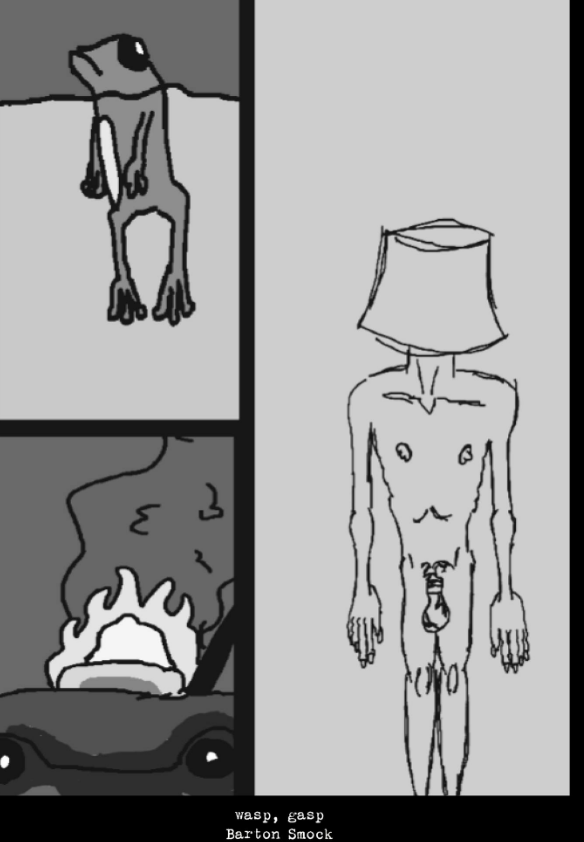
Am very grateful to David Mitchell for letting me do my thing, and for working with me on the cover image of the work, which is original art by my son Noah Michael Smock, as such:
Also need to deeply thank the number of poets and artists who said something toward the work before it was spoken correctly away. Such speech is below and I've put it inside anything above me.

Praise for Wasp, gasp.

Reading these poems is like assembling a kaleidoscope in a dim room and each jewel that finds its place lights up a glimpse of a spectacular depth. This collection of words is brilliantly surreal. Unlike much writing that's brilliant and surreal, these pieces hold their contents with tenderness. After a while, the love shines through as more important than any sense one might make of lesser things.
-Kyla Houbolt, poet, author of Surviving Death

The worlds of these poems are apocalyptic. Is it the past searching for the present or the present searching for the past? How does one reconcile all of this life but trying to find the words. Touch, god, owl, moon, son, daughter, Mom, Dad, brother. Sex. Ohio. The movies. Baby. Death. The things we brush up against that tell us we are living / that tell us we are also dying. The insidiousness of religion, but also the saving grace of belief or worship. It is clear that Smock worships the word and the world the word can build - a boat. When I read Barton Smock’s work I never want it to end and I always want it to end because it strikes me deep in my heart. He writes in birthplace 76 I want to have these talks. Dog parts and lost hell. My hair dead longer than yours.  These poems - a child stunned to find themselves an adult, the search for answers seems meaningless, and yet here is the word, building a ladder out of the muck. Here is the word continuing to make sense of all that has been lost. Of all that will.
-Jane Stephens Rosenthal, poet and filmmaker

This is powerful stuff, ripped from place of dream and nightmare, love and song, a deeply personal voice is given form here.
-Jon Cone, poet, author of New Year Begun

To read Barton Smock is to unlock a sliver of a Midwestern surrealist's (frog-less) dream. Here, God is often in the other room, consumed by the death of childhood and the stylings of the continual family, where famine and loneliness and love all succumb to the image-driven line. To the sideways divine. Grief as a sting. Most of Smock's poems (of which, he has thousands) are often a couple dozen words. Rarely more than a paragraph. A snippet. A breath. A postcard to bury in the ground, its flowers to be shaped like ancient ghosts. Barton Smock's newest ode is his collection Wasp, Gasp, a lyrical visit through childhood handstands and Ohio backlands and lackluster devils expelling hunger in a drunk stomach discovered in someone else's coat. To tackle the line is to fine-tune the prayer-in-hiatus, the blessed text of sleep. This book is the drink. This train is the king.
-Benjamin Niespodziany, poet, author of No Farther Than The End Of The Street

Smock leverages paradoxes, non-sequiturs, and wordplay to pulse out euphonious theophanies. With each succeeding poem, he intones nightmares and dreams the reader awake.
-George Salis, author of Sea Above, Sun Below

Barton Smock knows something that time also knows, continuing & carving out his own path within a rich tradition of surrealist-absurdist poets blazing a poetic path seemingly out of thin air. Smock’s poetic is filled with a stark heart & curiosity which leans on the unknown as much, or more, as on the known. This is the voice of a seer. The voice implores, becomes plural, rages & laughs & cries & asks. At times, a lost & reluctant prophet who heeds that "some places exist only after you reach them twice." Smock sees the deepness within himself, and perhaps, within all living beings in unison. And this may be one of my favorite gifts of Wasp, gasp—the poet’s way of approaching himself & this very existence with the same amount of integrity, imagination & nervous wonder. Wasp, gasp is a poetry of astoundment which I can foresee standing the test of time simultaneously with Al-Khazneh, Machu Picchu & Stone Henge alike.
-Daniel Cyran, poet, curator and editor of Anvil Tongue

I have lived in Ohio, and experienced its liminal qualities. Both an antiheaven and an antihell, it has the peculiar promise of being illegible from within and without. The narrator's body in Wasp, gasp is also illegible in this way, vibrating slowly between life, death and something else. In this space made by vibration, another something-else can emerge, in sonic play and folding images. God and dog circle one another then flop onto the ground, roll around. I know the demands of a liminal body in a place that won't hold it, what that might create. Barton Smock invites a reader to enter that zone too, the place that is a mode of being, one form of secret (or secret form) revealed:
The more internal/ the life, the longer/ the past./ A velvet cricket.
-Jay Besemer, poet, author of Men and Sleep

~

And, a reading of the work is HERE

On Goodreads, HERE
A black leaf is trying to make a fist

A baby
is scraping
by
Sleep has its own stomach

Which one of us
is hungry
changes

so one of us
isn’t
I don’t know
what’s worse
god liked
me once
SUKUN
New and Selected Poems
Kazim Ali
Wesleyan University Press, 2023

Anxiety is the cure for anxiety. I want to worry on a corrected yesterday about the world. Belief, behave. The writing of Kazim Ali has always given my smallness a place to re-shadow the reshaped. But that’s the least of its giving. In Ali’s Sukun, the touched new and the pristine selected reveal themselves as differently chosen under the sameness of an art lit by the singularity of twinned inquiry. Such utterances are blessedly sick with a patience that approximates the space between god-distracted angels. Grave, ghost, gargoyle- by which clock does stillness begin to age? Longhand language and the would-be theft of silence. This is time’s early work.

~

reflection by Barton Smock

~~~~~

Previous reflections on the work of Kazim Ali:

Silver Road
essays, maps & calligraphies
Tupelo Press, 2018


‘my hunger hungry to tell me’ – {from} Search Me

I have told myself repeatedly, in context, that the brain is there to recount for the body how form was ripped from non-existence. I know to know wrongly. This Silver Road, by Kazim Ali…I’m not sure it’s real. By which I mean one can be drawn to a thing that leads to its own unprovable arrival. By which I mean I’m not sure it happened. I have been trying to write about it for weeks. I won’t say words failed me, but will say I have been worried the words will know how I’ve responded. Silver Road is spotless. Is deeply marked. I scrawled, or thought to my others, throughout:

weather the self

mother more creatively

death is an environmentalist

page 84, the poem ‘Theft’. return to it and say again fuck.

I have sought solitary permissions, and have done so to be convinced I’ve become. Ali corrects loneliness. This is the same book that changed my past.

~

Inquisition
Wesleyan University Press, 2018

Do strangers make you human – {from} Drone

This odd exactitude. This thisness. These inhabited levitations. These spiritual hashtags for the redactions of Babel. This poetry….found, founded, in Kazim Ali’s Inquisition.

To know there is always another text.

In a different book Jesus
never suffered, never was flogged or died
went whole into heaven without passion – {from} The Earthquake Days

To command, with embodiment, form.

…do swear oblivion
Has its own markers but where the buoy
Of being clangs its stellar ore – {from} All One’s Blue

This is a searching work, a locating text, and its voice is one that makes of ground a hymn to some future itinerary. Ali is a believer in, a writer of, histories unmade by a record-breaking presence. If he wanders into the loneliness of the long distance runner, it is to appear as the clocker of isolated sprints.

(I weep like a stone)

(Really close to) two – {from} Forgotten Equations

Sail or spin I endless ember – {from} The Labors of Psyche

These are verses, redrawn, from a borderless awe. Unmothered anecdotes that fact-check the paternal past of the overtaken visionary. Were poem to erase all I pretend to love, I could live hearing such a speaking as is here, with how it addresses the now with a deepened next.
God is only god when god stops watching.
I ask for my weight in longing.
I ask
in the after of our again-death

for my weight
in Ohio
longing.

In Ohio
Ohio
is worried. The called-off search

for the person
who’s never
lonely.
frostbitten
birthdays
the moths
vanish
all except
the one
that I press
to my stomach
like a mother’s
mother’s
mother’s
ear
yours
mine
mother
who
There is not
in me
a heartbroken
ghost

It’s okay

My whole childhood I treated my thoughts
as bones

After all, after all
After all this light
A moth

can’t be starved
by god
I absolutely love Babak Jalali's Fremont. For how it memorializes memory, for how it details and decorates the abandoned time machine of place, for how its characters believe they are pressed for words when they are actually pressed for how to language them, for its inward humor and outward heroics, for the path it cuts for heartbreak, for the space it leaves the unfixed, and and and. And nothing I’ve said really says anything that speaks to what this film creates a voice for. As Donya, Anaita Wali Zada’s performance is both wall and fly, a movement based on a waiting impatience, a look looking for a look back. Visibility is no healer. Witness, no miracle. And yet, you’ll see, if you haven’t already, something new, here. Something wonderfully made. Familiar, far away, whole.

.

Karim Ouelhaj's Megalomaniac is mean, mad, and sad as fuck. A brilliance in its desperation. A sobbing in its violent glories. Pay attention to what it shows. Almost anti-exploitive. Eline Schumacher is a revelation whose performance ditches the revelatory to be instead a human from trauma's first future. It's demonic through and through, and raises the living.

.

Via hyper engaged writing that re-imagines tired time travel and horror fantasies into a very awake grindhouse style teen movie that's progressive in both its reverse reverence and anti-homage, Jennifer Reeder's idea-driven and visually off-road Perpetrator invades and enhances spaces usually reserved for male histories and occupies the timeline thereof by overthrowing the mundanely comfortable with the bizarrely familiar. Kiah McKirnan makes her impossible performance relatable long enough to give it teeth, and short enough to quicken the blood might the heart reclaim its beating. There's so much here that even its revelations play catch-up to the known and the knowing.

.

Dustin Guy Defa's The Adults is a ferociously sad film, not a showstopper in sight, just all show all the time. As siblings, Sophia Lillis deepens everything she does and doesn't touch, Hannah Gross is hermetically raw, and Michael Cera channels Julia era Tilda Swinton and Taxi Driver era Robert DeNiro in a performance that marries mirrors to every fantasy he's been divorced from. Don't blink, it's gone faster than loss can lose.

.

Return has a future in Jagoda Szelc's Tower. A Bright Day. Just because it's ancient doesn't mean it's a demon. The world comes for us, despite our rituals. What is it about non-American performances that seem to be lived-in and okay with dying? None of this art matters if there isn't some recognizable earth. Anna Krotoska is revealing and familiar in her demands and commands and reprimands, and makes this whole thing human. What a perfect film. Humanistic, animalistic, so known, so unknown. It only takes a moment. The abyss, the void, the hour of confession, the always of nature, the possessed second. Good goddamn.

.

What an indictment of absolution, is Dea Kulumbegashvili's Beginning. Witness is a weak viewfinder. One mirror turns to salt, one to stone. Fire is just trying to see itself. Sorry, I got drunk. Watch this film anyway. Sober up.

.

Like watching a road movie in an empty house, Andrea Pallaoro's Monica is, by design, clumsily American, and, by detail, a hermetic ballet. Patricia Clarkson loses half her grip to illness beautifully, and we see the angel that saves her and the devil that rescues. Emily Browning and Joshua Close do well with small untouched touches, and Adriana Barraza looks at something we can only see. But the film belongs, and is given, to Trace Lysette, whose performance is a summoned stillness, a balance of childlike return and transformed vanishment. The last scene matters to all, but only because it feels like a first time for us and for them.

