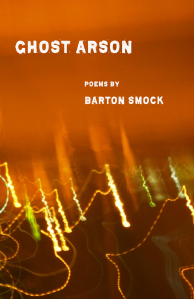
Ghost Arson
Poems . Barton Smock
Kung Fu Treachery Press, 2018
(no longer available, not in distribution)
Have some signed copies, 20$ each
via paypal (bartsmock@gmail.com)
or Venmo @Barton-Smock-2
or CashApp $BartonSmock
or Zelle bartonsmock@yahoo.com
Praise for Ghost Arson:
review by poet Dd. Spungin:
"Experiencing Barton Smock’s poetry is similar to living in a foreign country long enough to begin to understand the language.
Smock’s language is always intriguing, often foreign, more often brilliant in its ability to put images and concepts in the reader’s unsuspecting mind.
Certain poems/passages all but announce their meanings, as this from Gameshow Fatalities:
“see one of my children worrying less about suicide
and more about where it should happen. see: tub. see: easier
for a mother to clean.”
And some slide an idea into your consciousness such as this from Untitled:
“eternity
is a doll
reading
a menu, memorizing
a license plate
and doll
the first
eating disorder
in space”
Smock can shock, as well. Here, from Gestural Transportation, this standout stanza:
“the bread crumbs were eaten not by birds but by a
starving boy with a lost voice who’d wandered from his
home in a delirium brought on by a toothache. also,
Hansel & Gretel were two rich kids who killed someone’s
mother.”
The ethereal makes an appearance in the poem, Snow:
“say even god / would leave / this church
to step on the bones of a star”
Smock uses familiar subjects in much of his poetry: parents, siblings, children, but they are traveling in places that always surprise and make the reader stretch; it is a stretch most worthy of the effort.
To read these poems is a journey into a new art, and a privilege for the reader.
~
review by George Salis, author of Sea Above, Sun Below:
It seems to me that a lot of modern poetry is not poetry, but simply non-fiction with line breaks, so it’s refreshing to read modern poetry from an actual poet. As he first demonstrated with infant*cinema, Smock is conscious of language, of the power of a few words, or few words, and his mostly minimalist poems have the ability to evoke endless dreamscapes. The infinite from the finite, another paradox from paradoxical poems, poems that are like alternate or anti-paracosms. For example, here is one titled “Mooon.”
moan, fossil. how do my feet look in my mother’s belly?
my heart is a pink flame / is my father’s / fingernail.
father calls me antler. I don’t know this yet. I will be
shot
by many hands.
By simply including an extra ‘o’ in the word ‘moon,’ elongating what Sir Richard Burton called the “corpse upon the road of night,” Smock conjures a wolf’s howl, a cow’s lament, creatures of childhood’s imagination and myth. And then we are given the juxtaposition, the amalgamation of vestigial past and fetal future and beyond, to the (moon) shot of doctors? adulators? murderers? An unborn heart metamorphosing from flame to fingernail, or existing as both simultaneously, like Schrödinger’s cat, until postnatal wave collapse. The phrase “father calls me antler” tells a story in and of itself, a mysterious nickname/endearment/joke/snide….
Considering Ghost Arson as a collection, there are obsessions or at least repetitions: owls, milk, ghosts, etc. The pinnacle obsession being god in all forms and personalities (“you picture god as a toddler studying a map” or “the airway of a god with a tail”), the word itself repeated nearly to the point of semantic satiation, a term coined by Leon Jakobovits James, who also suggested that the phenomenon could be employed to ameliorate phobias. Consciously or not, perhaps Smock is attempting to exorcise a theophobia. Conversely, the recurrence could be a mantra reverberating across poems.
Some of my favorite images include:
“step on the bones of a star”
“a snake made of milk”
“ear-shaped mirrors”
“spacesuits for stillborns”
“the owl with hands”
Surreal and soft-spoken, to enjoy Smock’s work one must learn to take pleasure in balancing on the fringe of the unknown and admiring the abyssal veil that stretches before you with scintillations that echo fallen stars. Read him and dream.
~
Glen Armstrong, poet, from Cruel Garters:
I’ve been reading “Boy Musics,” a prose poem in the book Ghost Arson by Barton Smock. The poem perfectly captures that rarely whispered vulnerability that comes with being a boy (being human.) The poem opens with the speaker and his companion “counting cigarettes on the roof of a closed sex shop in Ohio,” an apt setting to explore what is open, what might be okay to share. The speaker shares that his father is gay; the companion shares “three poems by [his] dead sister, the third of which she called dead sister.” These kids are doomed, as left to their Mid-American whatever as Ohio, as passed over as the lower middle class. It’s “too late for crow and all the deer have been hit.”
Still, there’s a tenderness here. Poetry survives unlikely odds, as does sex. Smock confesses only what needs confessing. The poem and its companions in Ghost Arson never fail to surprise in their detail, and they never flinch as they stare down the big themes: “a vacuum runs below us. you ask me if I’ve ever wanted to see her handwriting. it’s nothing like yours but maybe one day.” These lines that conclude the poem give me shivers. This whole business is visceral. I love the book, but seeing the handwriting might break my heart.

 kingsoftrain